
Finding Your Customer: The Nuts and Bolts of Market Identification
Entrepreneurship requires a "blank sheet of paper" philosophy. This approach is championed by Bob Jones, a founder of four healthcare startups and a veteran turnaround CEO who once rescued a failing public company in Hong Kong by firing 75 people and rebuilding from scratch. Jones isn't just a suit; he’s a working blues musician who volunteers at homeless shelters as a "really nerdy guitarist," playing "non-violent music" to feed 1,000 people on Thanksgiving. This blend of technical rigor and street-level empathy is the foundation of identifying the customer.
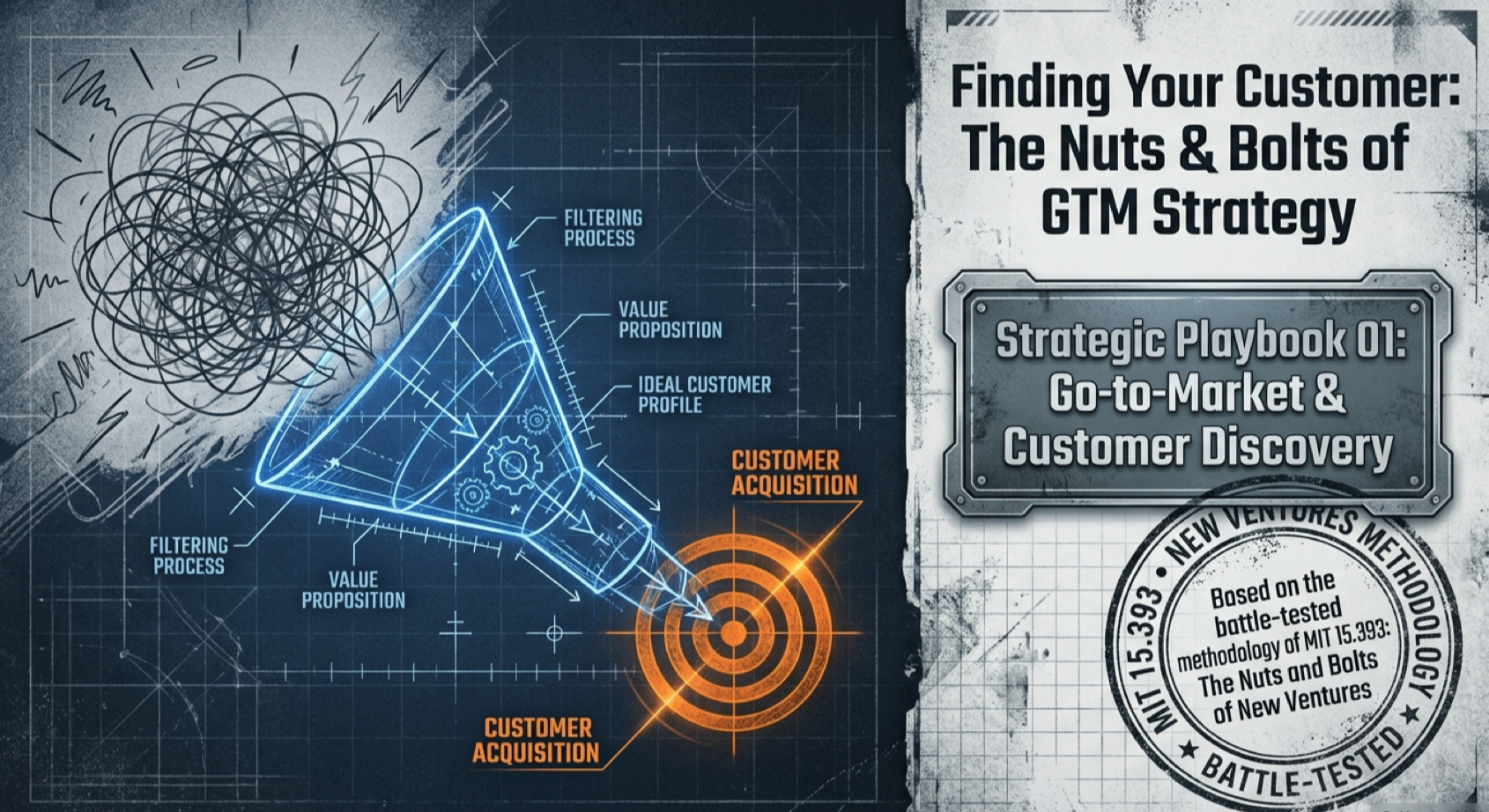
1. Introduction: The Academic vs. Entrepreneurial Paradigm
In the halls of traditional academia, market identification often gets buried under "lofty academic concepts." In the MIT course 15.393, "Nuts and Bolts of New Ventures," these are characterized as distractions like "risk-averse mean-variance utility maximization" or "quadratic utility functions"—theories that, while intellectually stimulating, have never been empirically demonstrated to build a business.
Entrepreneurship requires a "blank sheet of paper" philosophy. This approach is championed by Bob Jones, a founder of four healthcare startups and a veteran turnaround CEO who once rescued a failing public company in Hong Kong by firing 75 people and rebuilding from scratch. Jones isn't just a suit; he’s a working blues musician who volunteers at homeless shelters as a "really nerdy guitarist," playing "non-violent music" to feed 1,000 people on Thanksgiving. This blend of technical rigor and street-level empathy is the foundation of identifying the customer.
2. The Fundamental Question: "Should I Do It?"
The graveyard of startups is filled with founders who asked, "Could I do it?" and answered with a resounding "Yes" based on technical feasibility. The entrepreneurial consultant asks a different question: "Should I do it?"
To answer "Should I," you must perform the "Math of Survival." A business prospers only when it generates enough revenue to exceed its costs, and that revenue depends entirely on the value of the specific customer segment you target.
The Math of Survival
Target Monthly Revenue Goal: $5,000
Scenario | Data Point | Value per Customer | Customers Required | Operational Complexity |
A: Beginners (Kids) | $25/hr, 2x a month | $50/month | 100 | Extreme: High churn, massive acquisition effort. |
B: Seniors (Socializing) | $50/hr, 2x a week | $400/month | 12 | Low: Sustainable, high-touch, manageable. |
The Strategic Key: You are not just choosing a market; you are choosing your workload. A business with 12 high-value customers is a viable venture; a business requiring 100 low-value customers is a grueling hobby.
3. Identifying the Real Customer: Users vs. Economic Buyers
A common failure point is the inability to distinguish the person using the product from the person writing the check.
The User: In the default guitar lesson model, the users are "nerdy kids" looking for a hobby or a way to meet girls.
The Customer (Economic Buyer): The parents are the ones paying the $50/month. Their motivation is low, and their price sensitivity is high.
By shifting to the "Adult/Socializing" segment, the user and the customer become one and the same. This customer is motivated by the desire to "feel like Godzilla" after playing a Santana tune in an ensemble. They are paying for a social experience and "cool factor," which justifies the $400/month price point.
Strategy Insight: In your venture, if the user and the buyer are different people, you have two different sales jobs. Whenever possible, align them to reduce friction.
4. Case Study: The "Regain" Failure and the Retail Trap
Bob Jones’s story of "Regain," a nutrition bar for kidney dialysis patients, is a masterclass in how not to identify a customer. Regain was scientifically superior, with clinical trials published in prestigious journals proving it extended lives by replacing liquid supplements for fluid-restricted patients. It was an "absolute disaster," selling less than 10% of its forecast.
Failure Points Checklist
The Clinical Bubble: The team talked to doctors and dietitians who loved the science, but they never talked to the patients who had to spend their own money.
The Impact of Stephen Miller's 'AI' Strategy on Trump Administration
Explore the unconventional AI strategy Stephen Miller injected into Trump's administration. Discover the intricacies of this political maneuver and its ramifications on policy and governance.
Read ArticleThe "Self-Neglect" Profile: 75% of dialysis patients arrived there via mismanaged diabetes or high blood pressure. This demographic was historically unlikely to spend money on health-conscious snacks.
The Channel Blindness: The team knew hospitals but was ignorant of retail distribution.
The Retail Extortion: Slotting Fees
Startups often ignore the "Retail Trap." Major chains like CVS or Walgreens operate on sophisticated revenue-per-foot algorithms. To get on the shelf, you face:
Slotting Fees: Often $1 million per quarter just for the "slot."
Guaranteed Sales: If the product doesn't sell, the retailer returns it for a 100% refund.
Sample Mandates: You must provide free samples for every SKU in every store in the chain.
5. Case Study: "Night Bite" and Bypassing the System
After the Regain failure, Jones launched "Night Bite," a product for nighttime hypoglycemia. This time, the strategy moved from intellectual science to emotional reality.
The Emotional "Why": Focus groups revealed that patients weren't looking for "glucose management." They were terrified of dying in their sleep. They slept in recliners because they were afraid that if they got too comfortable in a bed, they wouldn't wake up.
Strategic Branding: Patients rejected medical packaging because they didn't want to look "frail." Jones used the name "Timed-Release Glucose" and "elite athlete" aesthetics. If a banker had to eat it during a long meeting, it looked like marathon runner fuel, not medicine.
The "Champion" Strategy: Jones identified Certified Diabetes Educators (CDEs) as his sales force. Their biggest frustration was "patient compliance"—patients simply wouldn't do what they were told. By providing a product that tasted like a "fudge brownie" and actually worked, the CDEs became a free, credentialed sales force.
Strategy Insight: In focus groups, the intellectual answer is almost always a lie; the emotional answer is where the market lives.
6. The Strategy of "Selling Customers to Retailers"
To enter major pharmacy chains without paying a dime in slotting fees, the Night Bite team executed a high-stakes "nuts and bolts" maneuver:
Demand Generation: Targeted ads generated 500+ calls a day. They hired anyone in Kendall Square with a pulse to answer phones and gather data.
The "Mabel" Tactic: When a customer wanted to reorder, Jones told them to call their local pharmacist. He leveraged "Mabel"—a loyal customer who had shopped at the same pharmacy for 27 years—to tell the pharmacist she’d be "mad" if they didn't carry the product.
The Wholesaler Stunt: At a New Orleans trade show, Jones sent free product to the 25 nearest pharmacies. He then called wholesalers (like McKesson) and told them the product was already in the local stores. To get into the wholesaler's system, he sent them a check for the margin they would have made on the free product.
The 15-Minute Meeting: In Clearwater, Florida, Jones met a buyer named "Jeff." While others offered bribes, Jones pulled out a list of 10,000 existing customers in Jeff's territory. He asked, "Which pharmacy should I tell these 10,000 people to go to?" He then invoked the Golden Rule of Negotiation: The next person who speaks loses. Jones sat in silence until Jeff blinked and gave him the shelf space.
7. Market Segmentation by Motivation
Traditional demographics (age, gender, income) are "graveyards" for startups. You must segment by motivation.
The Top of the Pyramid: These are people in immediate pain, fear, or greed (e.g., someone who just survived a heart attack). They are highly motivated to change their habits.
The Graveyard: The unmotivated masses (e.g., college students who have hearts but zero reason to worry about heart health).
Consultant Note: Startups are synonymous with "undercapitalized." Do not waste resources trying to convert the unmotivated. Even "God" (Amazon) can be a nightmare; they once classified a nutrition product as "hazardous material" and stopped distribution, proving that modern channels are minefields for those without a focused, motivated customer base.
8. Conclusion: Actionable Takeaways for Entrepreneurs
Finding your customer is about finding the "Warrior" (like the marathon runners who used sleep aids for recovery) rather than the "Working Mom" demographic the team initially guessed.
Five Golden Rules
Talk to them: Move past Google ads. You cannot understand a "warrior" until you hear their story directly.
Use Open-Ended Questions: Avoid the "Did you like it?" trap. Ask, "What did you think?" to uncover the unvarnished truth.
Identify what you are really selling: You aren't selling glasses; you are selling "seeing better." People don't want products; they want benefits.
Find your "Champions": Identify who else wins when you succeed (like the CDEs who finally achieved patient compliance).
Pitch in 10 Seconds: If you cannot explain your value in three sentences, you do not understand your customer. Mastery of the 10-second pitch is the ultimate skill: "Man who catch fly with chopsticks can do anything."
Topics in this article: