The Productivity J-Curve: Unveiling the Economics of AI Transformation
Explore the Productivity J-Curve in AI transformations. Learn why human investment is crucial for turning technological disruption into sustainable growth.
·4 min read·315 views·Intermediate
What is the Productivity J-Curve in AI Transformation?
The Productivity J-Curve describes the initial decline and subsequent rise in productivity when a general-purpose technology like AI is introduced. Performance dips as organizations invest in intangible assets before measurable improvements surface.
Understanding the Productivity J-Curve
When organizations introduce AI or any significant technology, they often experience a decline in productivity. This phenomenon, known as the Productivity J-Curve, highlights the initial dip in performance before sustained growth occurs. This period involves significant investments in intangible assets such as capability building and governance restructuring.
Formation Before Performance
AI doesn't just automate tasks; it redefines decision-making and value flow within an organization. To leverage AI effectively, companies must invest in complementary intangibles like redesigned processes and enhanced managerial capabilities. This phase is often felt by employees long before it's reflected in metrics.
The Curve Made Visible
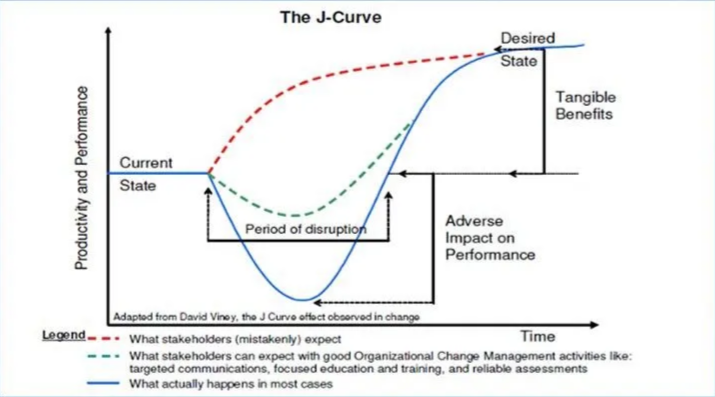
The J-Curve effect observed in change, showing productivity dipping during disruption before rising. (Graphic: David Viney)
The J-Curve illustrates the dip in productivity during organizational disruption, followed by a rise to a higher performance state. Stakeholders often expect a smooth upward trajectory, but the reality involves a temporary dip.
Structural Imbalance in Capital Allocation
A common issue in transformations is the imbalance in capital allocation. Typically, 80-90% of resources go towards technology, with only a small fraction invested in leadership and organizational capability. This imbalance hampers the upward turn of the J-Curve.
AI as a Test of Organisational Coherence
AI systems amplify existing organizational structures. Any ambiguity in governance or purpose becomes magnified. Effective AI integration requires clear leadership alignment and robust organizational coherence.
From Implementation to System Architecture
Successful organizations treat transformation as systemic redesign, not mere technology deployment. They focus on aligning leadership with shared decision-making frameworks and designing governance that integrates AI with human oversight.
The greatest risk during AI transformation is not the technology itself but the premature withdrawal of investment in capability when discomfort peaks. This leads to incomplete accumulation of intangible capital and stunted productivity gains.
Recommended Reading• Business
The Impact of Stephen Miller's 'AI' Strategy on Trump Administration
Explore the unconventional AI strategy Stephen Miller injected into Trump's administration. Discover the intricacies of this political maneuver and its ramifications on policy and governance.
A mature approach to transformation recognizes that productivity follows the formation of coherent leadership and organizational capability. This requires structured alignment across the enterprise, ensuring that technology investment translates into durable performance.
Your Next Step: Aligning People and Customer Strategy
The shift from traditional transformation requires rethinking capital allocation towards both technology and organizational capability. For senior leaders, the question is not if to invest in people, but how to do so in alignment with enterprise strategy.
Key Takeaways
The Productivity J-Curve is an essential framework for understanding AI transformation.
Effective transformation requires balancing technology investment with human capital development.
Long-term success depends on systemic redesign and organizational coherence.
Frequently Asked Questions
What causes the initial dip in the Productivity J-Curve?
The initial dip is caused by the investment in intangible assets like capability building and restructuring, which temporarily disrupts existing processes.
How can organizations shorten the disruption phase?
By investing in leadership alignment, governance clarity, and capability development, organizations can moderate the depth and duration of the disruption phase.
Why is capital allocation important in AI transformation?
Capital allocation is crucial because it determines whether the organization invests adequately in both technology and the complementary capabilities needed for sustained growth.
What role does leadership play in the J-Curve?
Leadership plays a critical role in aligning organizational strategy, ensuring coherent decision-making, and guiding the investment in intangible capital.
If this resonated — or if you violently disagreed — I'd like to hear from you. I work with a small number of founding teams each quarter. If you're building something real, book a discovery call or connect with me on LinkedIn.
Let's Collaborate
Ready to build something real?
I work with a small number of founding teams each quarter to launch products, mentor engineers, and integrate custom AI systems. Let's determine if we are a fit.
Direct & selective advisory • Limited slots available